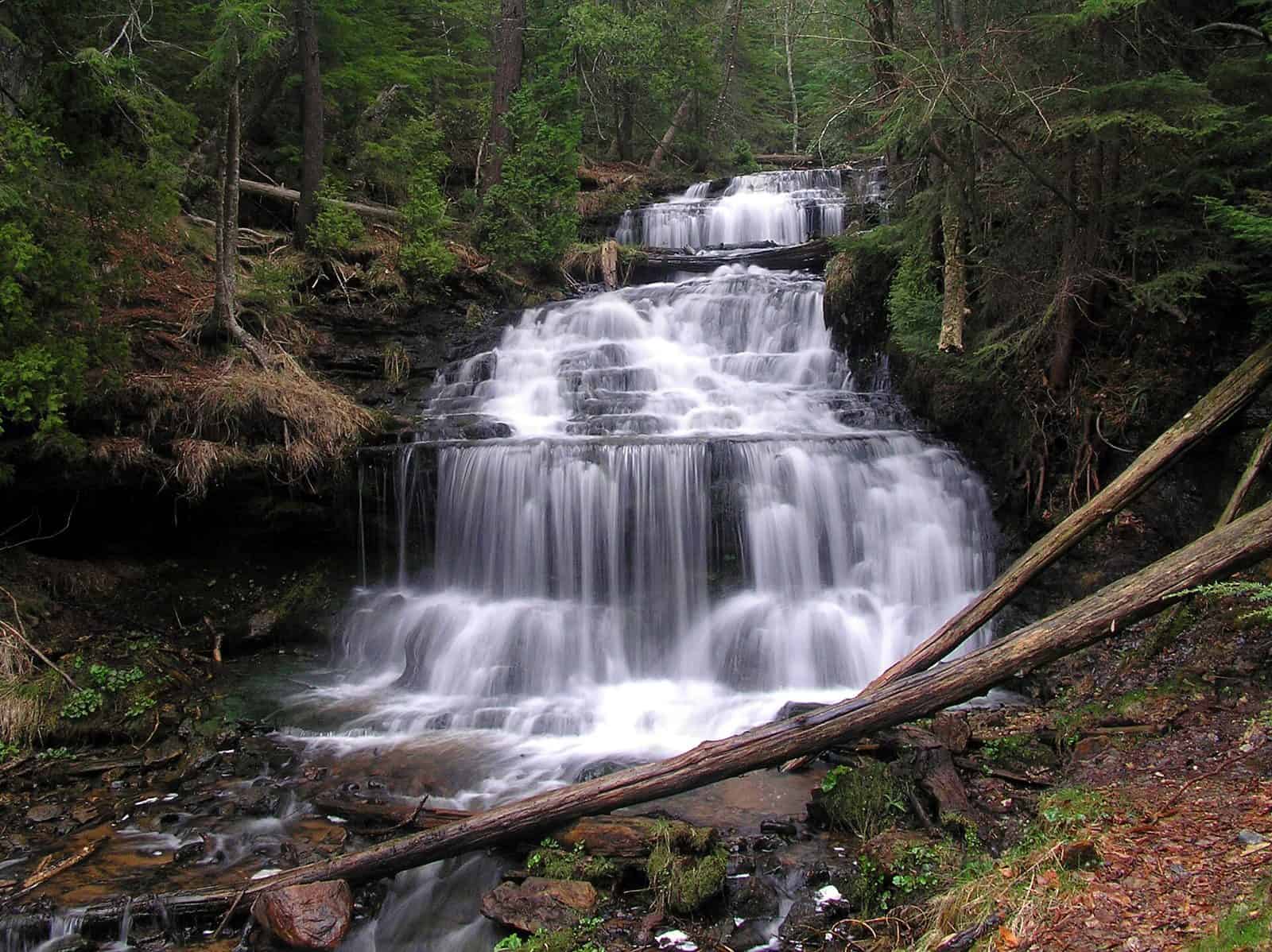
Spanning nearly 900,000 acres across Michigan’s Upper Peninsula, Hiawatha National Forest offers a landscape shaped by the Great Lakes—rugged shorelines, dense hardwood forests, and over 100 miles of pristine rivers and streams. Established in 1931, the forest is divided into eastern and western units, each with distinct character. The eastern section hugs the Lake Superior and Lake Huron shorelines, while the western unit borders Lake Michigan near Escanaba.
The North Country National Scenic Trail cuts through the forest, providing access to some of the most remote backcountry in the Midwest. History buffs can explore the Point Iroquois Lighthouse, now a museum overlooking Lake Superior’s Whitefish Bay. The forest’s 43 campgrounds—including Pete’s Lake, Three Lakes, and Little Bay de Noc—range from developed sites with amenities to primitive walk-in locations for those seeking solitude.
Peak season runs from late May through October, with summer bringing warm days ideal for paddling the forest’s designated Wild and Scenic Rivers. Fall transforms the landscape into a corridor of blazing maples and birches, typically peaking in late September. Winter opens opportunities for snowmobiling and cross-country skiing on groomed trails.
Access the western unit via US-2 near Escanaba, or reach the eastern sections through M-28 and M-123. Forest roads are generally well-maintained but can become impassable during spring thaw and heavy snowfall. A Northwest Michigan National Forest pass is required for day-use parking at many trailheads and recreation areas.
Explore Nearby
- Palms Book State Park — State Park in Michigan
- Wagner Falls Scenic Site — State Park in Michigan
- Munising Rear Range Light — Lighthouse in Michigan
- Munising Front Range Light — Lighthouse in Michigan
- Wisconsin Lake Superior Byway — Scenic Byway in Wisconsin