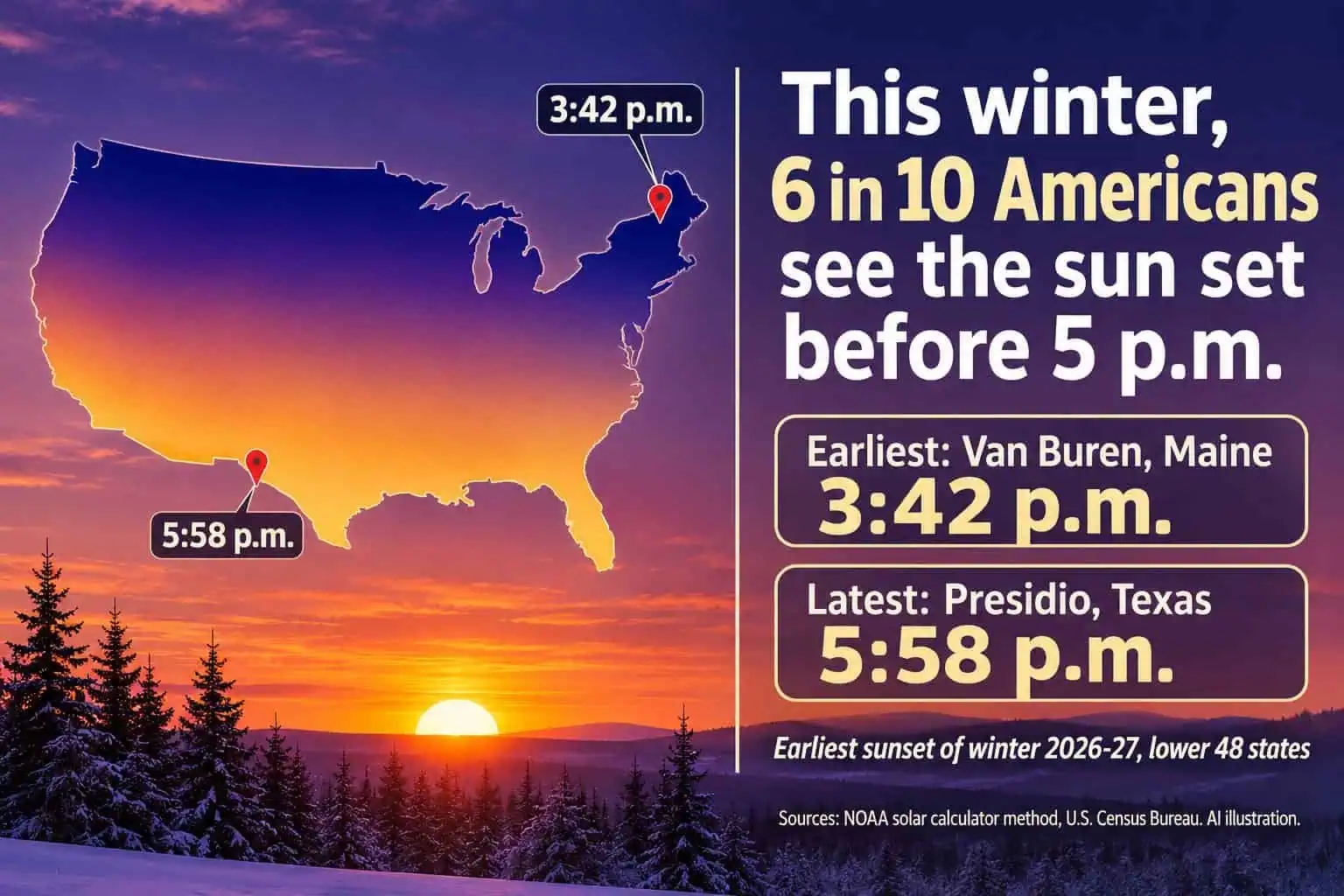
This winter, 6 in 10 Americans will see the sun set before 5 p.m. Type your town to see your earliest sunset, the day it happens and when a 5 p.m. sunset comes back.
Sunset times: NOAA's solar calculator method. Population: U.S. Census Bureau.
Each town's earliest sunset this winter, lower 48 states (NOAA method):
Times are for the town's center on flat ground, rounded to the minute. Hills and tall buildings make it darker sooner.
The map: who gets dark first
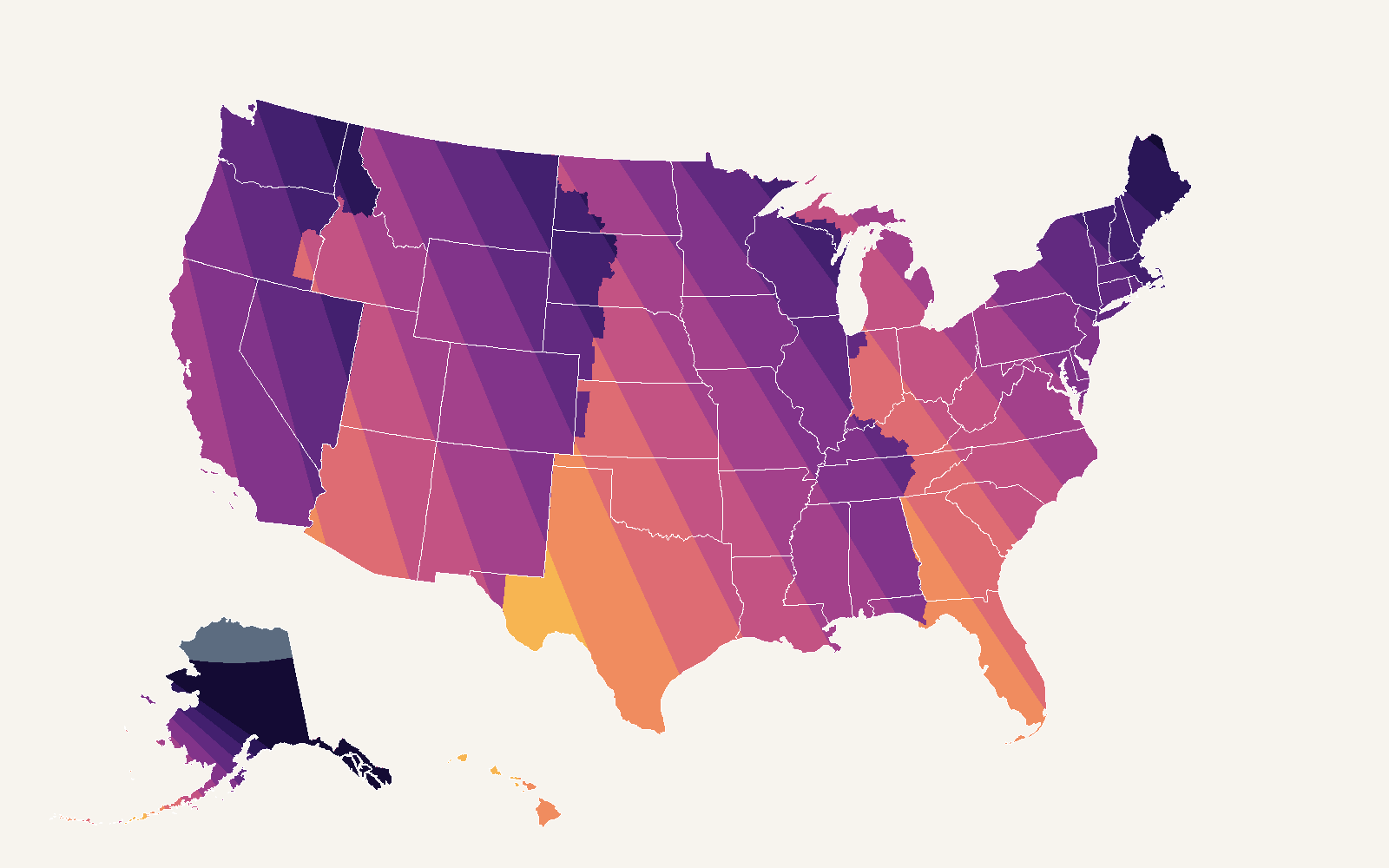
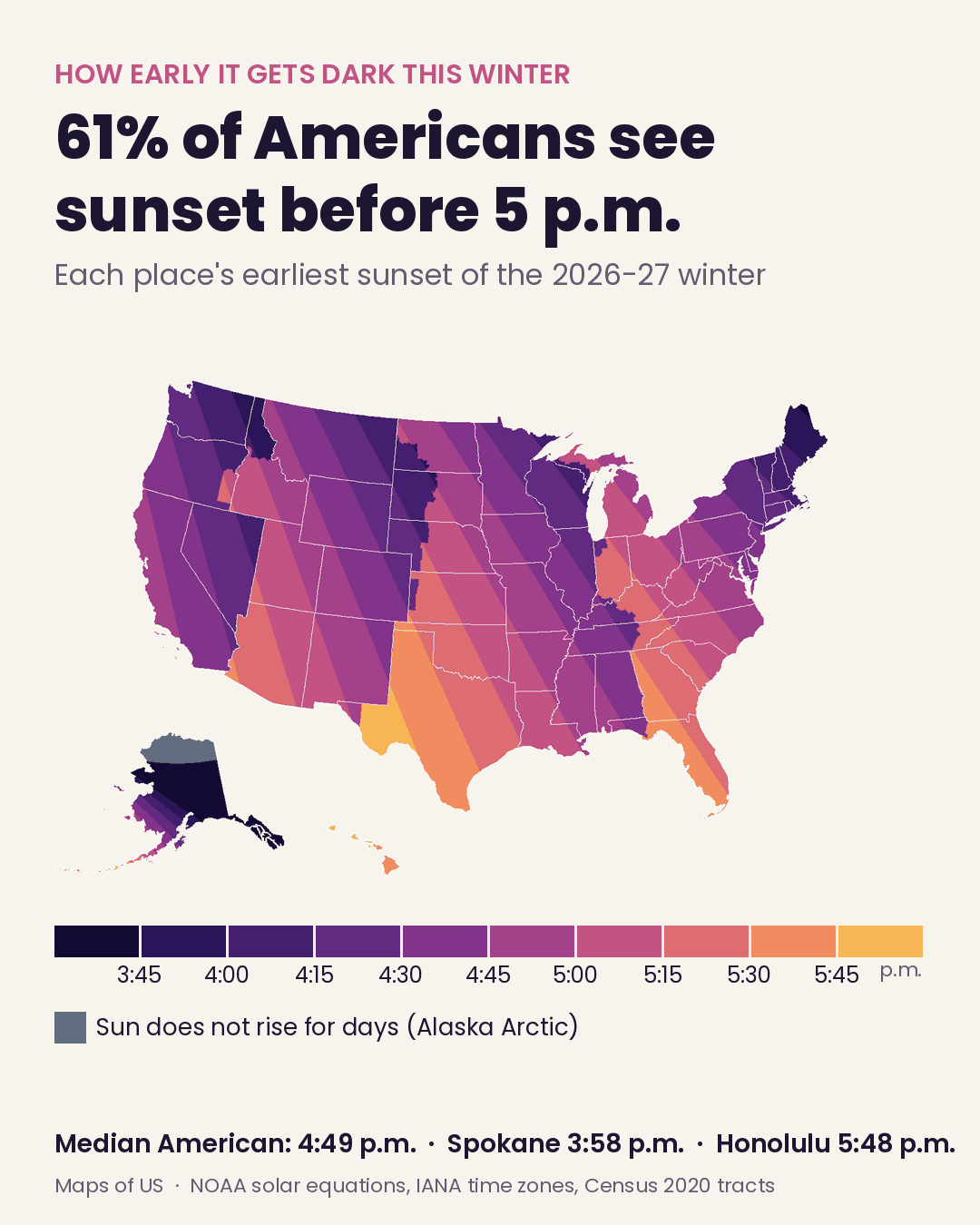
Each color is a place's earliest sunset of this winter. The dark purple corners are where evening comes soonest: northern Maine, the Idaho Panhandle, western North Dakota and Alaska. The orange belt is where it stays light latest, mostly on the western edge of each time zone.
Half of Americans live where the earliest sunset is or earlier. About 1 in 5 (%) get theirs before 4:30.
Download the map card (PNG) Download every town (CSV)
Your earliest sunset is not on Dec. 21
The shortest day is Dec. 21, but the earliest sunset comes about two weeks before that, in early December. Mornings keep getting darker until early January. Why: solar noon, the moment the sun is highest, slides later on the clock all winter. In New York it's 11:40 a.m. on Nov. 3 and 12:01 p.m. on Jan. 4, because Earth moves fastest in its orbit in early January and because of the tilt of its axis. So sunrise and sunset both drift later each day, even while the day is still getting shorter.
Here is when a 5 p.m. sunset comes back in big cities. Cities with no date never see the sun set before 5 p.m.
The big city where it gets dark first: Spokane
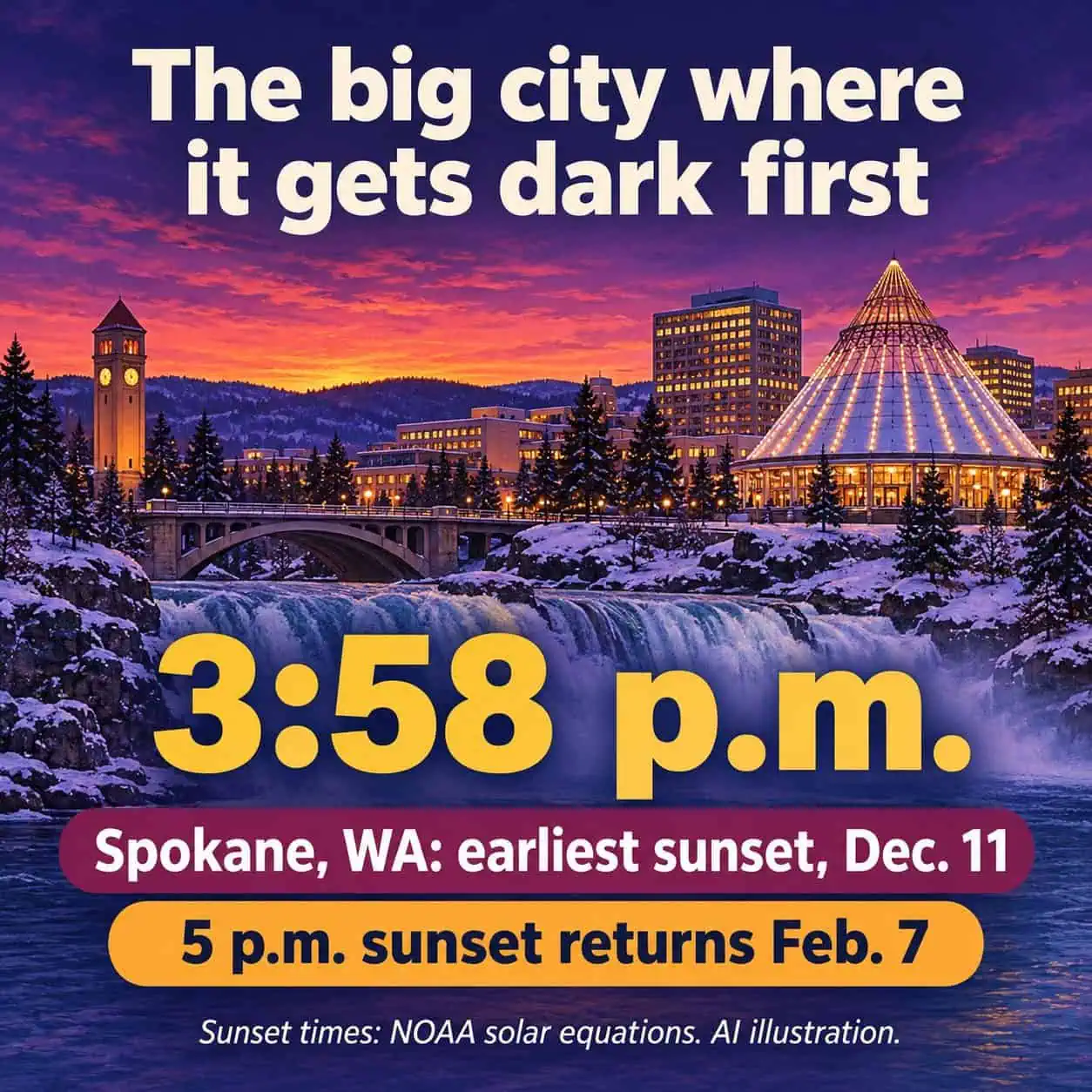
Of the cities in the lower 48 with 200,000 or more people, Spokane, Wash. gets the earliest sunset: on . It sits far north and on the eastern edge of Pacific Time. Within a time zone, everyone shares one clock, but the sun sets about 4 minutes earlier for every degree you go east, so towns on a zone's eastern edge get dark first.
Boston comes next at , then Worcester, Mass., at . Seattle, much farther west in the same time zone as Spokane, gets . Spokane doesn't see a 5 p.m. sunset again until .
| Big city (200,000+) | Earliest sunset | Date | 5 p.m. back |
|---|
The 10 earliest and 5 latest of places with 200,000+ people. Anchorage, Alaska, is earlier still at .
Same time zone, almost 2 hours apart
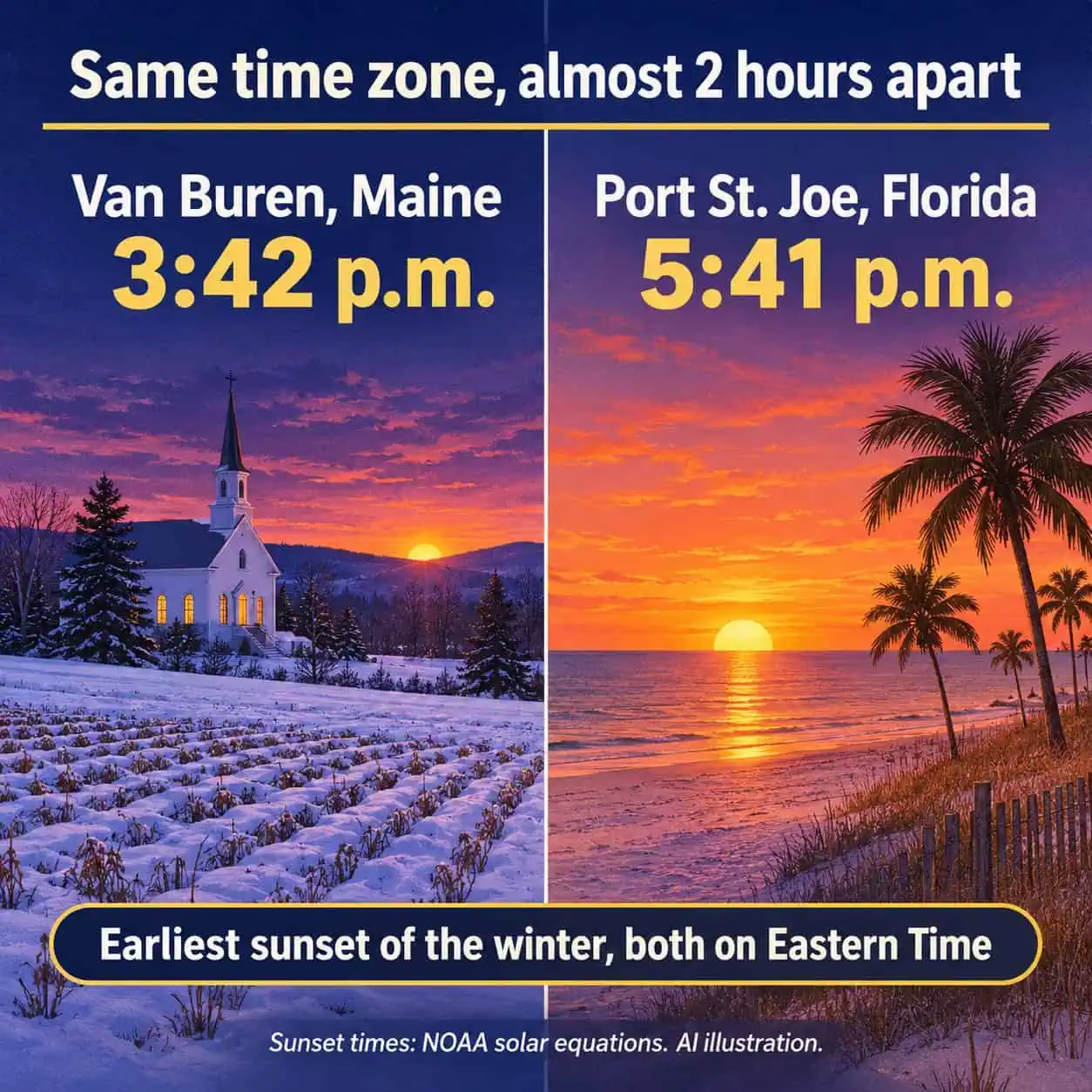
Eastern Time stretches from the top of Maine to the Florida Panhandle. In Van Buren, Limestone and Grand Isle, Maine, the earliest sunset is 3:42 p.m., the earliest of any town in the lower 48. In Port St. Joe, Fla., it's 5:41 p.m. Same clocks, a gap of .
Among cities of 100,000 or more on Eastern Time, Boston () and Tallahassee () are minutes apart.
Chicago vs. Indianapolis: 164 miles, one hour
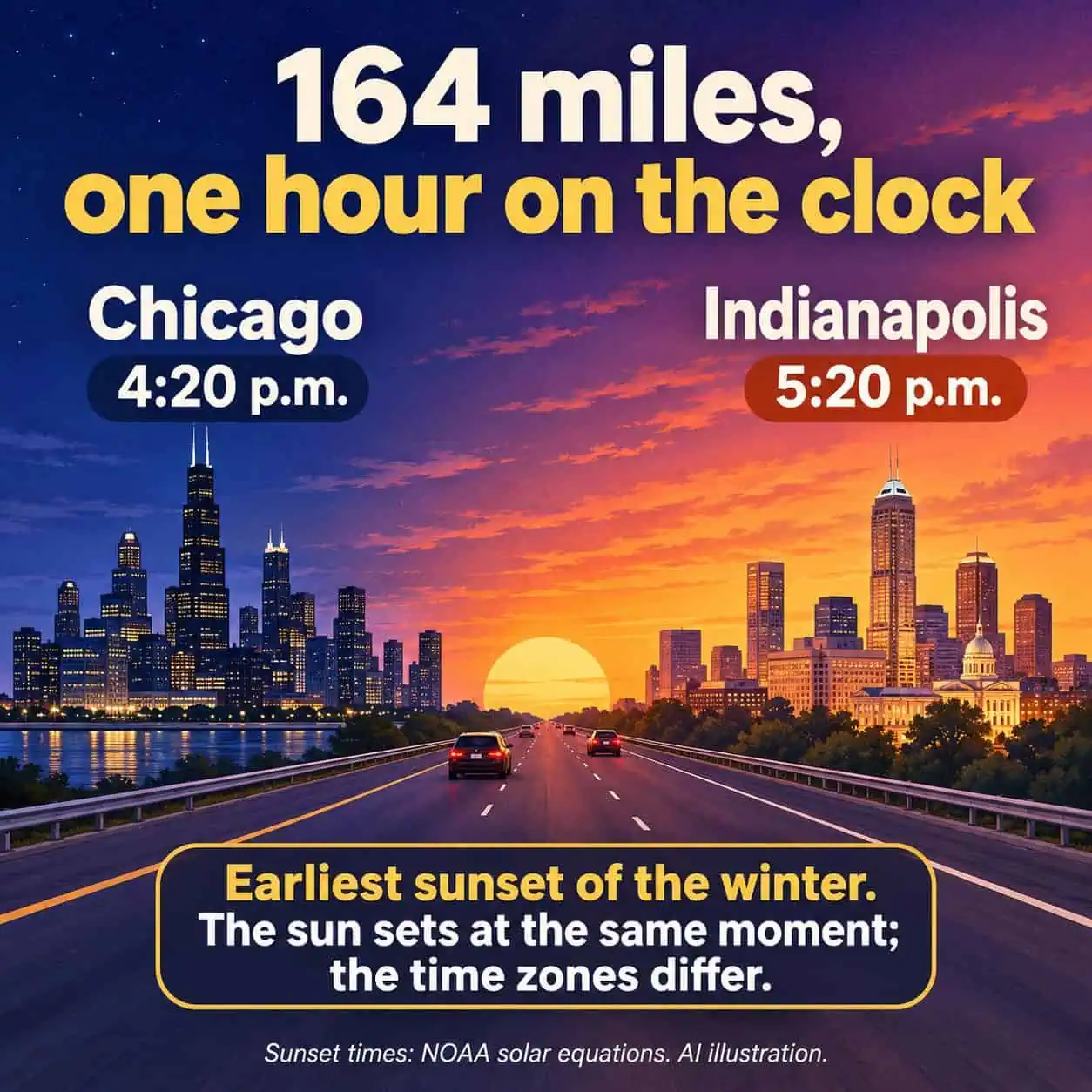
Chicago's earliest sunset is . Drive miles southeast to Indianapolis and it's . The sun sets at almost the same moment in both cities, but Indianapolis is on Eastern Time and Chicago is on Central, so the clocks show an hour's difference. The time zone line runs along the Indiana–Illinois border for most of the way; only Indiana's corners near Chicago and Evansville use Central Time.
Indianapolis never sees a sunset before 5 p.m. this winter. Chicago waits until .
Boston vs. Atlanta: same clock, 78 minutes apart
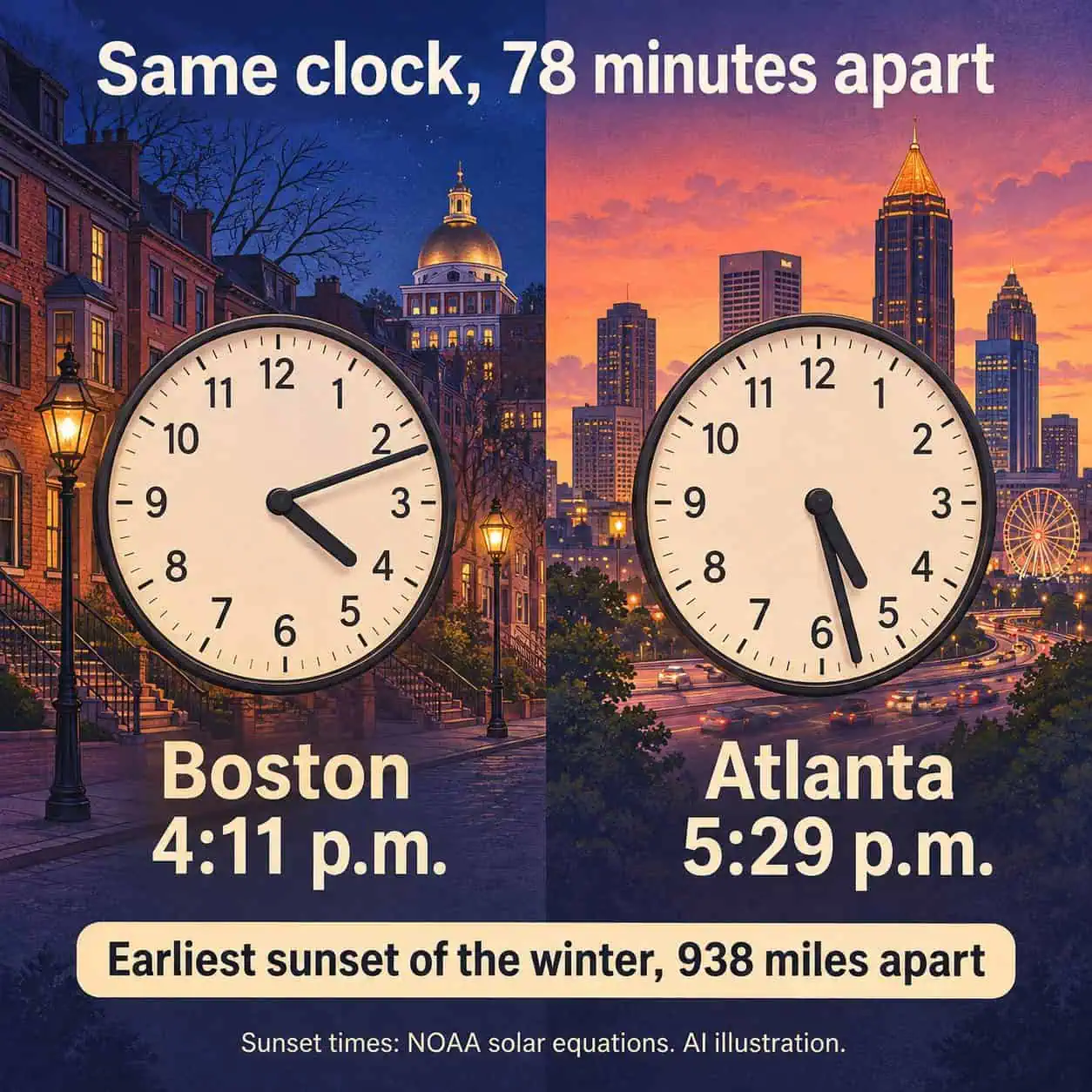
Boston and Atlanta are both on Eastern Time and miles apart. Boston's earliest sunset is ; Atlanta's is . Atlanta is farther south, so its winter days are longer, and farther west, so the sun sets later by the clock.
Detroit sits in between. At about 83° west, it is far west for Eastern Time, a zone built around 75° west (near Philadelphia), so its earliest sunset rounds to exactly 5:00 p.m. ( minutes after Boston's). On Dec. 21, Boston gets of daylight and Atlanta gets .
Utqiaġvik, Alaska: 64 days without a sunrise
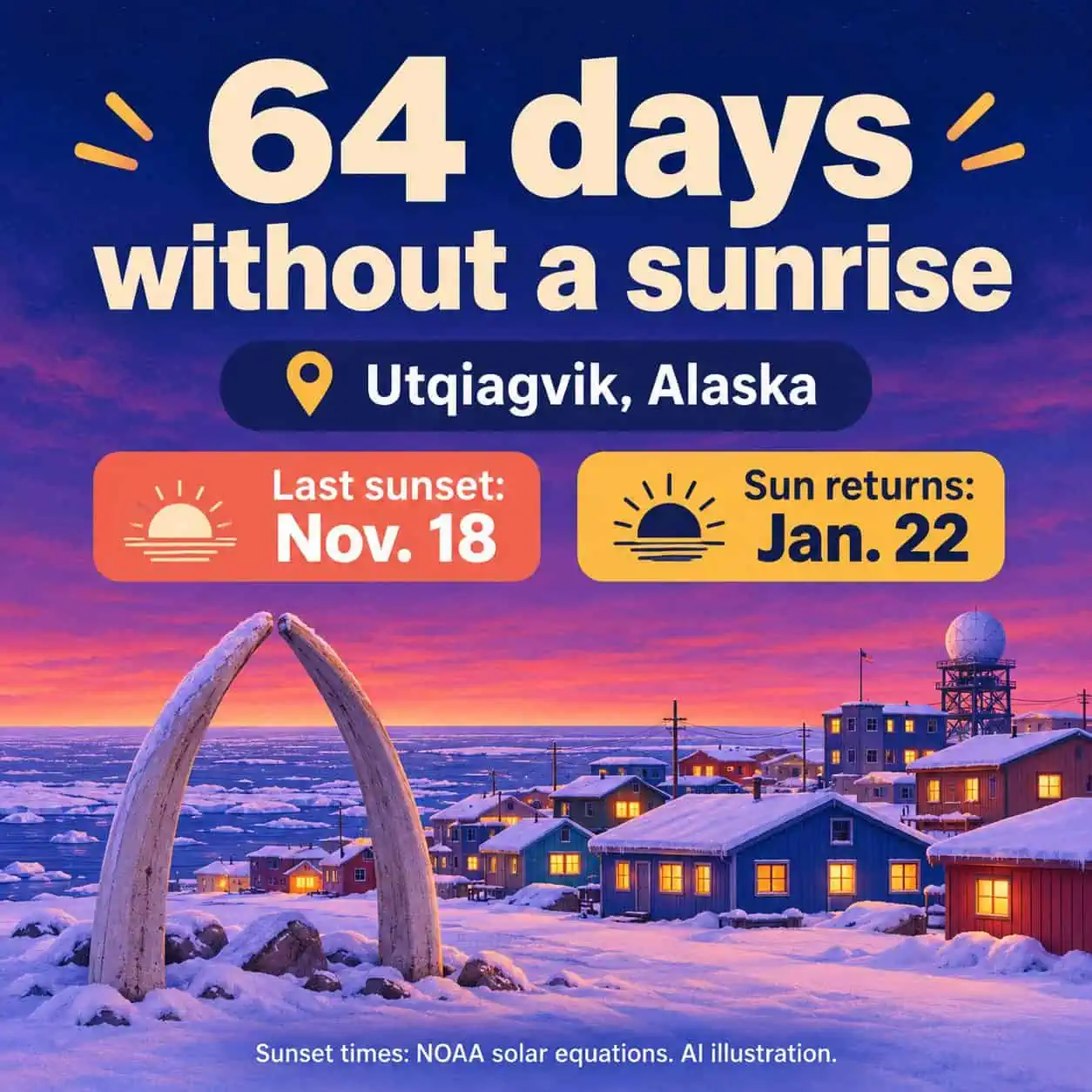
In Utqiaġvik (formerly Barrow), America's northernmost town, the sun sets on at and doesn't come back up until . That's days with no sunrise. This happens above the Arctic Circle, where Earth's tilt keeps the sun below the horizon for weeks around the winter solstice. It isn't pitch black all day: there are a few hours of twilight around noon.
Alaska towns get at least one day without sunrise. Farther south, Fairbanks still gets a sunset, at on , with of daylight on Dec. 21. Juneau's earliest is ; Anchorage's is .
Where winter sunsets stay late
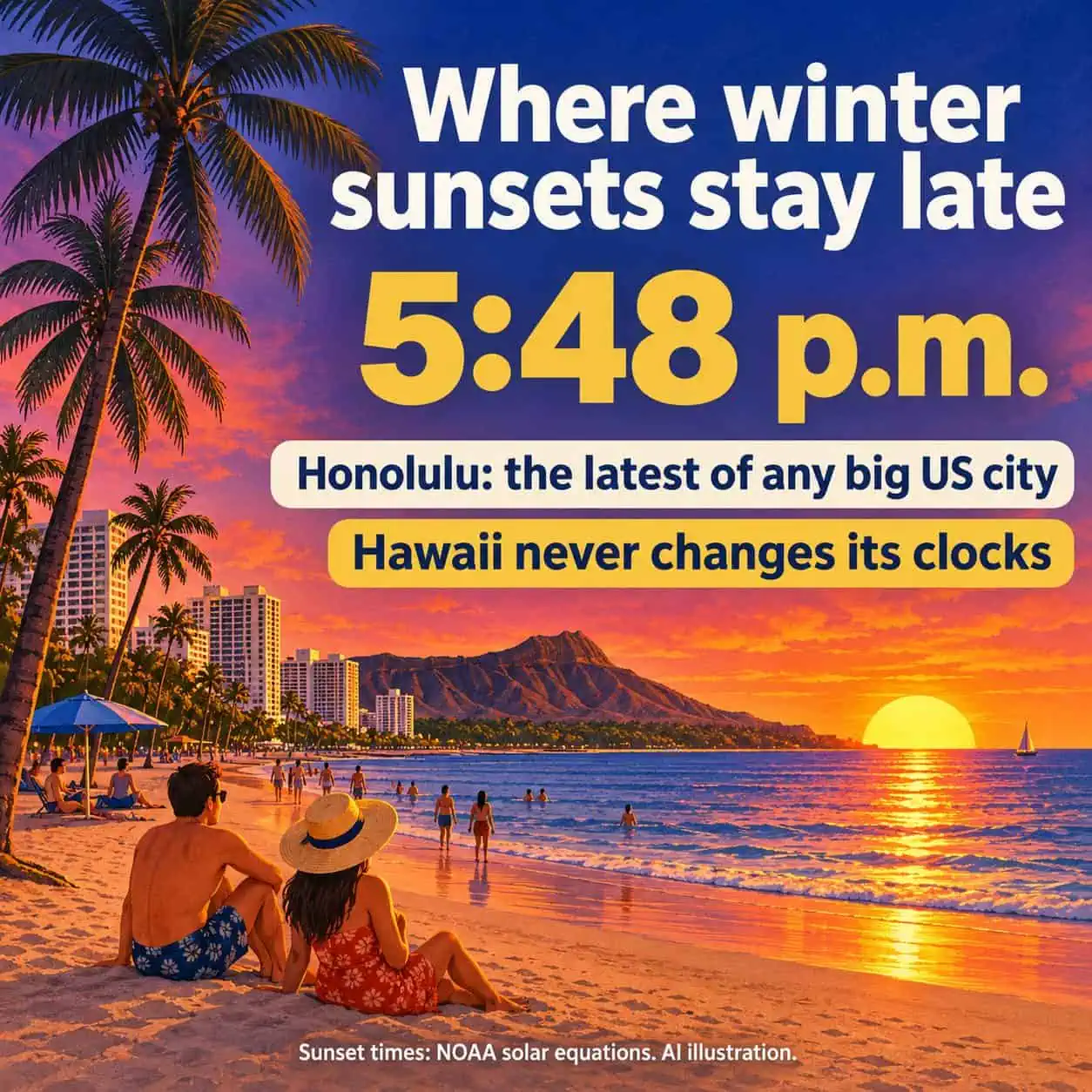
Hawaii, most of Arizona and Puerto Rico never change their clocks, and all three get late winter sunsets. In winter that isn't the reason (everyone is on standard time until March); they are simply far south, where winter days are longer. Honolulu's earliest is , the latest of any US city with 200,000+ people. San Juan's is and Phoenix's is .
The late-sunset champions of the lower 48 are in far west Texas: Presidio and Redford at 5:58 p.m. They're on Central Time, a zone built around 90° west, but they sit at about 104° west, almost on Mountain Time's center line, so the sun sets nearly an hour later by the clock than it would in the middle of the zone.
The darkest evening isn't the shortest day
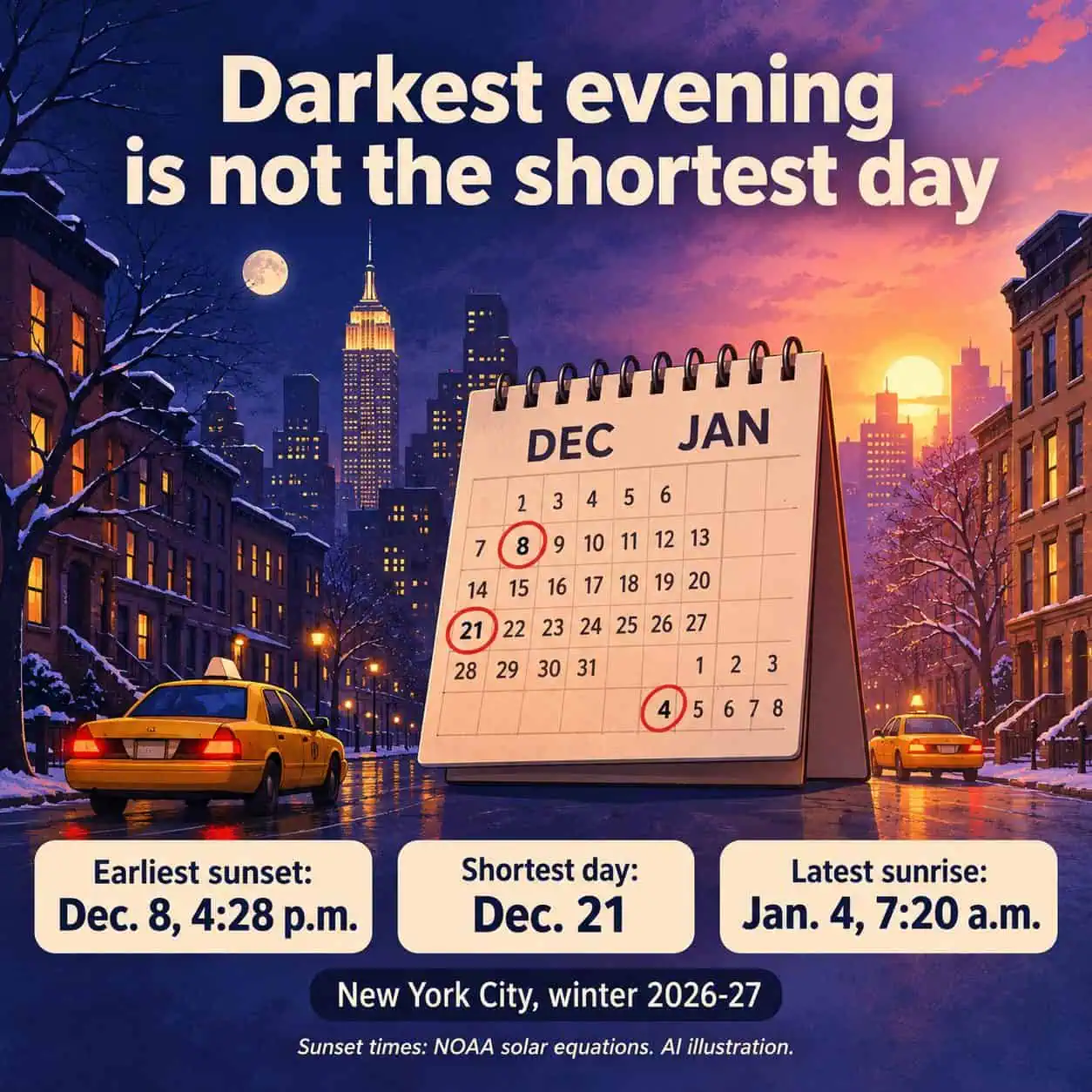
New York City shows how this works. Three different days stand out:
So the evenings start getting lighter almost two weeks before the shortest day, while mornings keep getting darker until January. By , New York's sunset is back to 5 p.m.
How we calculated this
- Sunset and sunrise: NOAA's solar calculator equations, for every day from Nov. 1, 2026, to March 31, 2027. Sunset is when the top of the sun drops below a flat horizon (sun center 0.833° below), the standard used by NOAA and the US Naval Observatory. "Last light" is the end of civil twilight (6° below). We checked our math against the US Naval Observatory for Boston, Spokane, Detroit, Honolulu, Phoenix and Utqiaġvik; times match within a minute.
- Clock time: the official time zone rules (IANA time zone database) and time zone boundaries from the open-source Timezone Boundary Builder project (OpenStreetMap). A few towns follow a neighbor's clock unofficially, such as Phenix City, Ala., which uses Eastern Time; our boundaries treat it that way too.
- Places: all cities, towns and census-designated places (named communities with no town government, which the Census Bureau maps) in the 2025 Census Gazetteer, at each place's official center point. Population: Census American Community Survey 2020-2024.
- Share of Americans: 2020 Census population centers for people in 50 states and D.C.
- Rounding: times are rounded to the nearest minute. The earliest sunset is the day with the earliest exact time. "5 p.m. comes back" is the first day after that when sunset rounds to 5:00 p.m. or later.
- Images: the map and charts are built from the data. The illustrations are AI-generated (GPT Image) and labeled.
Sources: NOAA Global Monitoring Laboratory solar calculator; US Naval Observatory; IANA tz database 2026; Timezone Boundary Builder 2026f; US Census Bureau Gazetteer 2025, ACS 2020-2024, 2020 tract centers of population. Fonts: Poppins, SIL Open Font License 1.1.